
Stopping Trains in an Emergency
Make contact with the signaler to stop trains
|
Date Issued: |
Drafted By: |
Role: |
|
30/05/2025 |
Philip Sargent |
Senior Network Lead |
|
Issued To: |
||
|
All station staff including agency partners. |
||
|
Line of Route: |
Station: |
|
|
Entire network |
All stations |
|
|
Subject: |
Key Message: |
Category: |
|
Stopping Trains in an Emergency |
Make contact with the Signaler to stop trains |
Safety |
Overview
Keeping staff and customers safe is the first and foremost responsibility of any railway company or professional. When an emergency occurs, it is vital that the correct actions are taken to keep people safe and to prevent a serious incident from occurring.
If you come across any instance where there is a danger of death or serious injury to staff, passengers or members of the travelling public from moving trains, the Signaller must be telephoned to stop the trains using signals and you need to be ready to stop the trains using hand signals.
The poster accompanying this briefing is designed to guide how to handle such situations:
What types of scenarios prompt the need to stop a train in an emergency?
Any instance where there is a danger of death or serious injury to staff, passengers or members of the travelling public from moving trains. Examples include:
- A person trapped in closing train doors or in contact with a train that is about to depart
- Trespassers / members of the public on or near the line
- An unauthorised person retrieving an article from the track
- An obstruction on the railway line
- A large animal (e.g. a cow, horse or sheep) on or near the line
- A person in contact with, or at risk of contact with overhead wires or a conductor rail
- Damaged Electrified Line Equipment
- A railway bridge struck by a road vehicle
Please note this list is not exhaustive. As a guide, any situation that could endanger the safe passage of trains or injure someone on or near the railway should be treated as an emergency.
How do I stop a train in an emergency?
- Phone the Signaller
- Stop oncoming trains by raising two hands in the air. In the hours of darkness or poor visibility, by waving any light vigorously.
Any such incidents should also be phoned through to ARL Control and logged in your station log book. Please also be careful to keep yourself safe, including that all interventions should be done from a position of safety on a platform.
Who can I call for support?
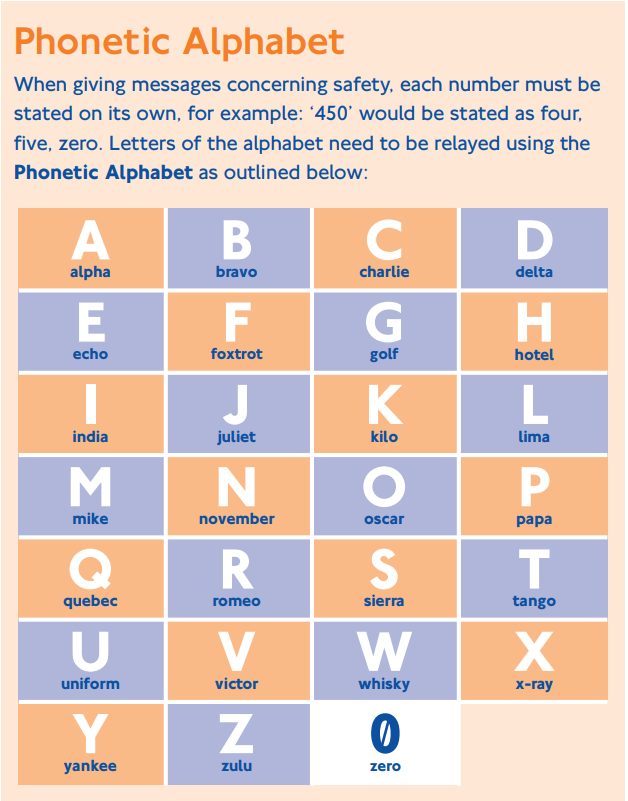
In the event of anyone going on or near the line who shouldn’t be there, the first call should be an emergency to the Signaler using Safety Critical Communications skills as specified on the ‘Stopping Trains in an Emergency’ poster. However, more general guidance can be provided by a member of the ARL station management team or your agency supervisor or ARL Control.
In addition to this, there are circumstances where it will be appropriate to contact British Transport Police. In the instance of there being immediate danger to life, then they can be contacted by telephoning 999. For events that happened but are immediately over (eg trespass incident that has occurred but ended) then a text message to 61016 may be more appropriate.
What is expected of me?
- Read and familiarise yourself with the ‘Stopping Trains in an Emergency’ poster.
- Ask for further clarification on this subject if you have any questions.
- Ensure you know the correct signal box number to call for all platforms at your station, or for any stations that you work at. These should be written on the version of the poster displayed on your Health and Safety Notice Board and saved on your station mobile phone.
- *If you have any queries regarding this, then please speak with your line manager or supervisor.

 Built with Shorthand